
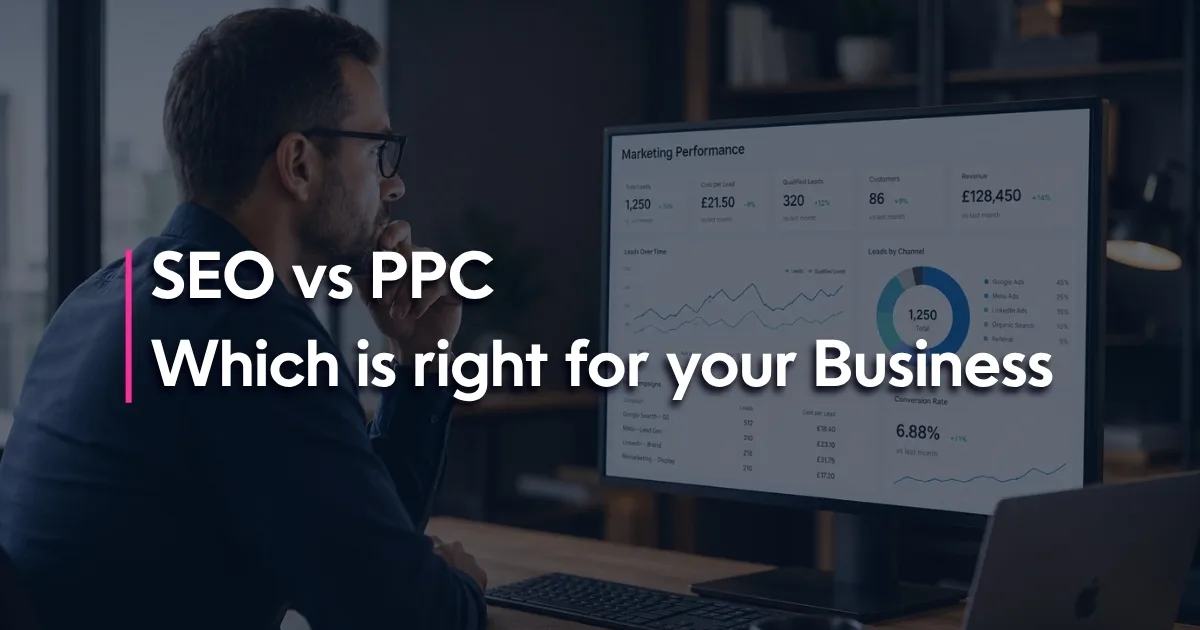
SEO and PPC are both ways to get your business in front of people searching on Google, but they work differently and suit different situations. SEO builds organic visibility over months and compounds over time. PPC puts you at the top of the results immediately, but stops the moment you stop paying. Most growing businesses in 2026 need both, but the right starting point depends on your budget, your timeline, and where you are in your growth.
What Is SEO?
SEO, or Search Engine Optimisation, is the process of improving your website so it ranks higher in Google’s organic search results. When someone searches “web design agency Bury St Edmunds” or “how to increase sales for my business,” the unpaid results they see are driven by SEO.
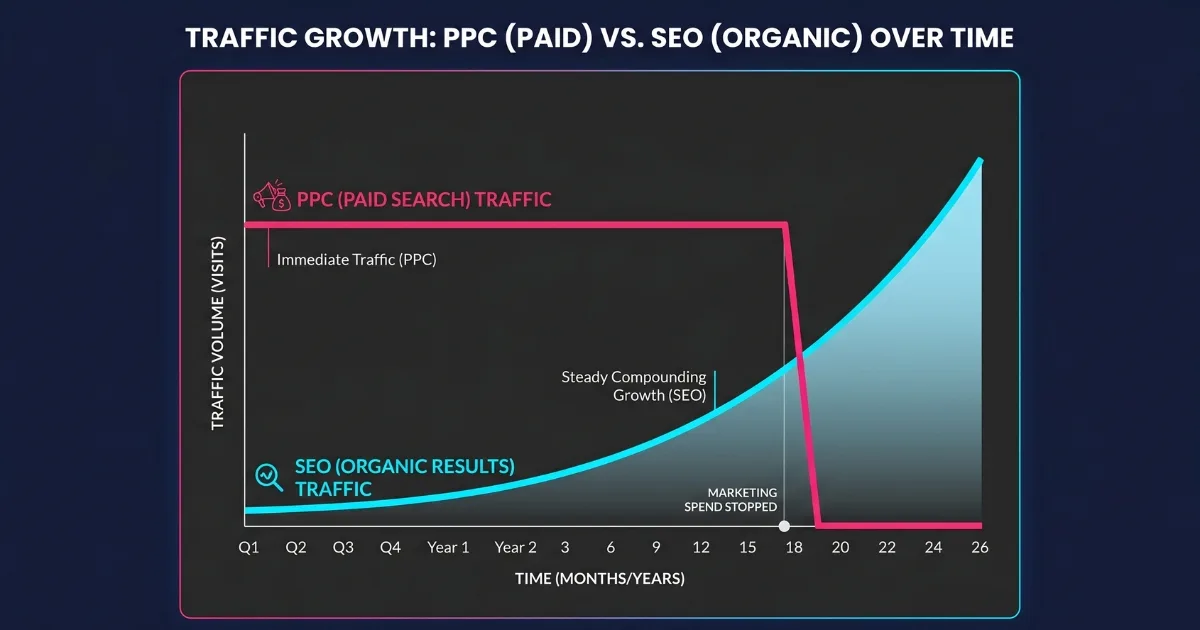
It takes time to build. Most businesses start seeing meaningful results between three and six months in, with the most significant gains coming at the twelve-month mark and beyond. But once you are ranking, the traffic compounds. You are not paying for each click, and the results do not disappear the moment your budget runs out.
What Is PPC?
PPC, or Pay-Per-Click, covers paid advertising through platforms like Google Ads, Meta Ads, and LinkedIn. You bid to appear at the top of the search results or in front of a specific audience, and you pay each time someone clicks your ad.
The results are immediate. A well-built Google Ads campaign can drive leads on day one. But it requires ongoing investment, active management, and skill. The moment you switch it off, the traffic stops.
The Case for SEO
The long-term economics of SEO are difficult to argue with. According to FirstPageSage, SEO delivers a median ROI of 748% over three years. That is roughly £7.48 returned for every £1 invested.
Compare that to the average cost-per-lead. Organic search generates leads at an average of £14 per lead, against £44 for paid search — a 68% cost advantage that widens as your rankings strengthen.
The trust factor matters too. Research by Sopro found that over four-fifths of B2B decision-makers trust organic search results more than paid ads. When a business owner in Cambridge or Ipswich searches for a marketing agency and you appear organically, you carry more credibility than the business that only appears in the ads column.
Organic search drives 53% of all website traffic globally, making it the single largest measurable traffic source across every sector. That is not a channel you want to ignore.
The introduction of Google AI Overviews has added a new dimension to this. Businesses that appear as cited sources within AI Overviews have been shown to earn 35% higher organic click-through rates than non-cited competitors on the same queries. This is precisely why content quality and authority signals matter more in 2026 than they ever have. If you want to understand how this is changing local search, our post on what SEO is and why it matters covers the fundamentals in full.
The Case for PPC
If SEO is a long game, PPC is a lever. Pull it and things happen immediately.
For businesses launching a new service, promoting a time-sensitive offer, or entering a competitive market where SEO will take time to build, PPC fills the gap. You appear at the top of Google on day one, in front of people who are actively searching for what you offer.
Google Ads also gives you control that organic search cannot match. You can target specific locations — Norfolk, Suffolk, Cambridge — specific search terms, specific times of day, and specific devices. You can test messages quickly, identify what converts, and scale what works.
PPC is also the right tool when the commercial intent behind a search is high. Someone searching “Google Ads agency Ipswich” or “web designer near me” is likely close to a buying decision. Capturing that moment with a well-structured campaign, a strong landing page, and a compelling offer can return an immediate result.
The challenge is cost. Average cost-per-click in competitive sectors can run well above £3 to £5 in the UK. Without skilled management and a properly structured campaign, budgets can evaporate quickly with little to show for it.
It is also worth understanding that Google Ads itself has changed dramatically. AI now controls much of how campaigns are built, optimised, and delivered — and that changes how you need to approach them. James Pointon, co-founder of Higher Performance Marketing, covers exactly this in the video below.
Watch: Google Ads Has Changed More in 12 Months Than in The Last 5 Years. Here’s What You Need To Know
The Key Differences Side by Side
Speed. PPC delivers traffic immediately. SEO takes three to six months minimum before you see meaningful organic movement.
Cost structure. PPC charges per click, every time, indefinitely. SEO requires upfront investment in content and technical work but does not carry a per-click cost.
Longevity. SEO compounds. A well-ranking page continues to drive traffic for years. PPC stops the moment you pause the campaign.
Trust. Organic results attract more inherent trust from users than paid ads. The top organic result earns approximately 39.8% of all clicks on a search results page, according to First Page Sage. The top paid result averages around 2.2%.
Targeting precision. PPC offers granular targeting by location, audience, device, and time. SEO targets through keyword and content relevance.
Which Should You Choose?
The honest answer is that this is the wrong question for most growing businesses. SEO and PPC are not competitors. They are different tools that serve different purposes, and the most effective marketing strategies use both.
That said, if you are starting out and need to make a choice, here is a practical framework.
Choose SEO first if you are building for the long term, you have time on your side, and you want to build an asset that compounds in value. If you are a business in Suffolk or Norfolk with a clear target audience and a service that people actively search for, SEO will build you something your competitors cannot easily replicate.
Choose PPC first if you need leads now, you are launching something new, or you are operating in a market where you cannot afford to wait six months for organic traction. PPC also makes sense as a bridge while your SEO builds.
The most effective position is to run both. Use PPC to drive immediate leads and gather data on which keywords and messages convert. Use SEO to build long-term authority and reduce your reliance on paid spend over time. Businesses that combine both channels capture a significantly larger share of search results pages — both the paid and organic positions — and build stronger brand authority as a result.
What Most £1m to £10m Businesses Actually Do
The businesses we work with across Cambridge, Norwich, Ipswich, and Bury St Edmunds typically come to us having already tried one or the other in isolation. They have either spent money on Google Ads without the right setup and seen poor returns, or they have been told to wait for SEO and grown frustrated by the timeline.
The answer is almost never one or the other. It is usually a properly structured campaign on both channels, with a realistic budget, a clear strategy, and the right agency managing it.
If you want to understand what a realistic marketing budget looks like for a business at your stage, our post on what a business should spend on marketing in 2026 gives a practical framework to work from.
And if you are trying to decide whether to work with an agency rather than manage this in-house or with a freelancer, our guide to choosing the right digital marketing agency covers what to look for and what to avoid.
At Higher Performance Marketing, we run both SEO and paid ads for businesses across East Anglia and beyond. If you want a clear view of which channel makes more sense for your situation right now, get in touch and we will give you a straight answer.
Frequently Asked Questions
1. Is SEO or PPC better for a small business?
It depends on your timeline and budget. PPC delivers immediate results but requires ongoing spend. SEO takes longer to build but compounds in value and delivers a significantly higher ROI over twelve months or more. Most small businesses benefit from a combination of both, starting with PPC for quick wins while SEO builds in the background.
2. How long does SEO take to show results?
Most businesses begin to see meaningful organic movement between three and six months after starting SEO work. Significant ranking improvements and consistent traffic growth typically come between six and twelve months in. The longer you invest in SEO, the greater the compounding returns.
3. What is the average cost of Google Ads in the UK?
Costs vary significantly by industry and keyword competitiveness. In the UK, average cost-per-click ranges from under £1 in some sectors to well over £5 in competitive markets such as finance, legal, and professional services. Management fees from an agency typically sit on top of your ad spend.
4. Can you do SEO and PPC at the same time?
Yes, and for most growing businesses this is the recommended approach. Running both channels simultaneously allows you to capture immediate leads through PPC while building long-term organic authority through SEO. Data from PPC campaigns can also inform your SEO keyword strategy.
5. Does PPC help SEO?
Not directly. Google has confirmed that paying for ads does not influence organic rankings. However, PPC and SEO complement each other strategically. PPC data reveals which keywords convert, which informs your SEO content priorities. And occupying both paid and organic positions on the same search results page increases your brand’s overall visibility and click share.
6. Which is more cost-effective in the long run?
SEO. According to FirstPageSage, SEO delivers a median ROI of 748% over three years, compared to approximately 155 to 200% for PPC. The cost-per-lead for organic search averages £14, against £44 for paid search. However, PPC offers value that SEO cannot — speed, targeting precision, and immediate control — which is why the most effective businesses use both.
About the Author
James Pointon is co-founder and director of Higher Performance Marketing. With over 30 years of experience in sales and marketing across multiple industries and locations throughout the UK, James has built and run his own multi-million pound business and has worked within his own businesses for the last thirteen years. That commercial background — not just marketing theory — is what shapes the way Higher Performance approaches growth for its clients.
Connect with James on LinkedIn | Higher Performance Marketing