
SEO (Search Engine Optimisation) is the process of improving your website so it appears higher in Google search results when potential customers search for your products or services. For small businesses, it is one of the most cost-effective ways to generate consistent, qualified leads. Unlike paid advertising, SEO builds long-term visibility that continues working even when your budget does not.
Watch: What Is SEO and How Does It Work?
If you prefer to watch rather than read, our director James walks through the essentials of SEO in this short video:
Why Small Business Owners Cannot Afford to Ignore SEO in 2026
Most purchasing decisions now begin with a search engine. A potential customer needs a product or service, they open Google, they type a phrase, and they click one of the first few results. If your business does not appear on that first page, for most practical purposes it does not exist to that person.
That is not an exaggeration. Research from Backlinko shows that the first result on Google receives around 27.6% of all clicks. By the time you reach position ten, that figure drops to just 2.4%. The second page barely registers at all.
For small businesses competing against larger brands with bigger marketing budgets, SEO levels the playing field. A well-optimised small business website can outrank a national competitor for the searches that matter most to local and niche audiences.
What Is SEO?
SEO stands for Search Engine Optimisation. At its core, it is the practice of making your website more attractive to search engines like Google, Bing, and increasingly, AI-powered platforms that surface results based on relevance and authority.
Search engines use automated programmes called crawlers to scan websites across the internet. They analyse the content on each page, the structure of the site, the links pointing to it from other websites, and hundreds of other factors. Based on this analysis, they rank pages in order of relevance and trustworthiness for any given search query.
SEO is the discipline of understanding those ranking factors and systematically improving your website against them.
How Does SEO Work?
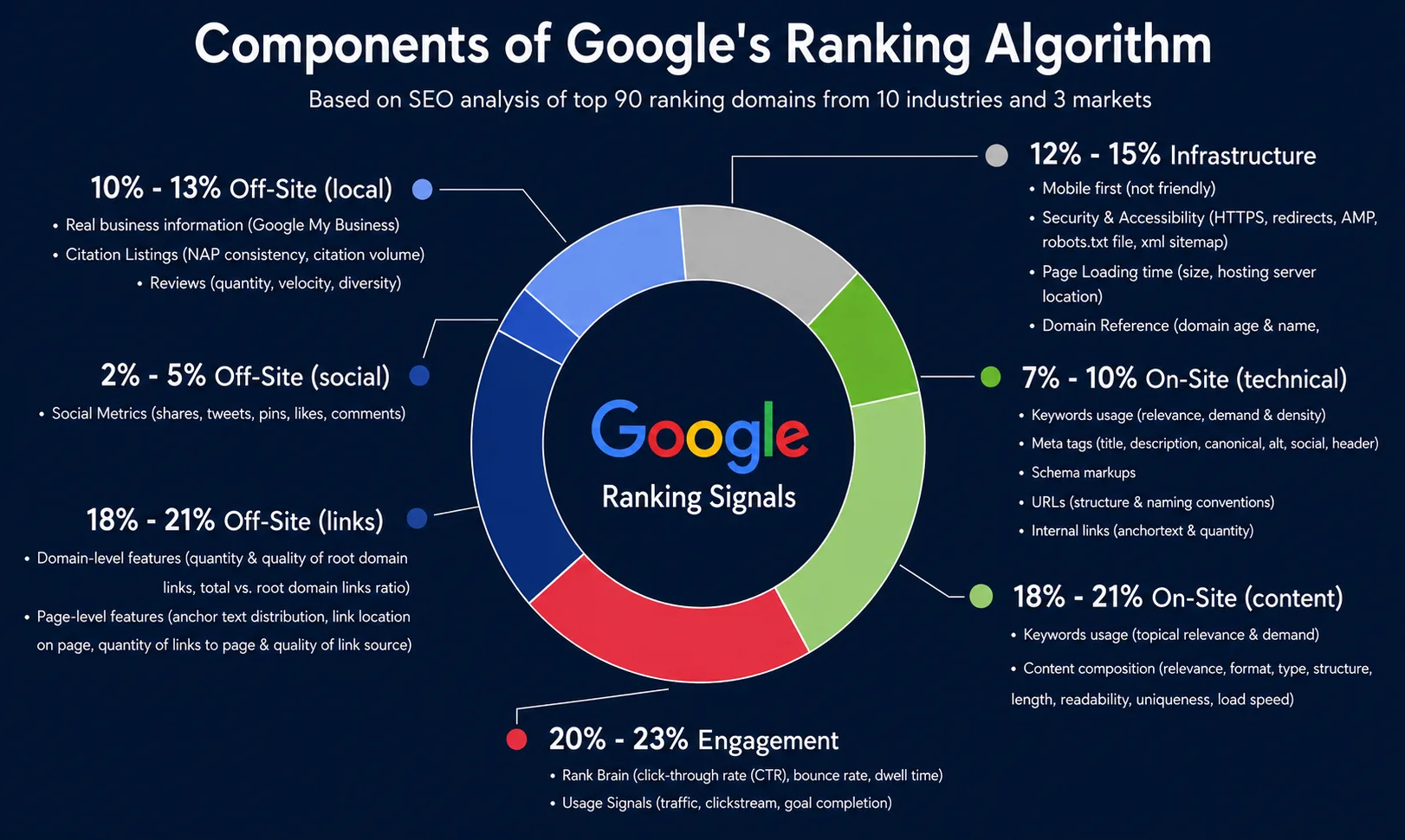
SEO is made up of three interconnected disciplines. Neglect any one of them and your results will be limited.
On-Page SEO
On-page SEO refers to everything on your website that you can directly control. This includes the words on your pages, the headings you use, the titles and descriptions that appear in search results, the images and how they are labelled, and how your content is structured.
The most important principle of on-page SEO is relevance. Your content needs to match what people are actually searching for, using the language they use, answering the questions they are asking.
Keyword research is the foundation of this work. By identifying the specific phrases your potential customers type into Google, you can create content that is precisely aligned with their needs at the moment they need it.
Off-Page SEO
Off-page SEO refers to signals from outside your website that tell search engines your site can be trusted. The most important of these signals are backlinks: links from other websites pointing to yours.
When a credible website links to your content, Google interprets that as a vote of confidence. The more high-quality backlinks you accumulate, the more authority your domain builds, and the easier it becomes to rank for competitive terms.
Off-page SEO also includes your presence in online directories, brand mentions, and increasingly, citations from AI platforms and language models.
Technical SEO
Technical SEO covers the infrastructure of your website. This includes how quickly your pages load, whether your site works properly on mobile devices, how easy it is for Google’s crawlers to navigate your site structure, and whether your pages are free from errors that could prevent them from being indexed.
A website can have excellent content and strong backlinks and still underperform in search results because of technical issues. Page speed is a particularly important factor. Google has confirmed that site speed is a ranking signal, and research from Google itself found that as page load time increases from one second to five seconds, the probability of a visitor bouncing increases by 90%.
Why SEO Is One of the Smartest Investments a Small Business Can Make
Paid advertising works. Run a Google Ads campaign and you will appear at the top of search results immediately. Stop paying and you disappear just as fast.
SEO works differently. The results take longer to appear, but they are not tied to an ongoing spend. A well-optimised page can drive traffic for months or years without additional investment. That changes the economics significantly.
Consider the comparison this way. With paid search, every visitor has a cost attached to it. With organic search, once you have earned your ranking, additional traffic costs nothing. For small businesses managing tight margins, that distinction matters.
Beyond cost, SEO traffic tends to convert well. People who find your business through organic search were actively looking for what you offer. That intent makes them far more valuable than someone who saw a display ad while doing something else entirely.
SEO also builds brand credibility. Ranking highly in Google is a signal that your business is established, relevant, and trustworthy. Many buyers will consciously or unconsciously factor that into their decision to contact you.
How Long Does SEO Take to Work?
This is one of the most common questions small business owners ask, and the honest answer is that it depends on several variables: how competitive your sector is, how established your website already is, how consistently work is being done, and what your starting point looks like.
As a general benchmark, most businesses see meaningful movement in their rankings within three to six months of starting a focused SEO programme. Significant traffic growth and lead generation typically become visible between six and twelve months.
That timeline can feel frustrating when you are used to the immediacy of paid advertising. But it is worth reframing it. The work done in month one continues compounding in month six, month twelve, and beyond. SEO rewards consistency and patience in a way that very few other marketing channels do.
What Should Small Businesses Focus on First?
If you are starting an SEO programme from scratch, the priority order matters. Trying to do everything at once dilutes effort and slows results.
Start with a technical audit. Identify and fix any errors that prevent Google from properly crawling and indexing your site. Speed issues, broken links, duplicate content, and missing metadata all need to be resolved before other work can have its full effect.
Next, build your keyword strategy. Understand exactly what your potential customers are searching for at each stage of their buying journey, from broad awareness searches through to specific purchase-intent phrases.
Then create or optimise content around those keywords. Every page on your site should have a clear purpose, a defined audience, and specific search terms it is designed to rank for.
Finally, build your authority through backlinks and off-page signals. This is a longer-term discipline, but the earlier you start, the sooner it compounds.
SEO and AI: What Small Businesses Need to Know in 2026
Search behaviour is changing. AI-powered tools like Google’s AI Overviews, ChatGPT, and Perplexity are increasingly answering questions directly, without users needing to click through to a website at all.
This has given rise to a new discipline called GEO, or Generative Engine Optimisation. GEO focuses on structuring your content in a way that makes it more likely to be cited or summarised by AI platforms, not just ranked in traditional search results.
For small businesses, this means the bar for content quality is rising. Vague, thin, or generic content is being filtered out faster than ever. Detailed, authoritative, well-structured content is being surfaced and cited more frequently.
The good news is that the fundamentals of strong SEO align closely with what AI platforms are looking for. Businesses that have invested in quality content and technical optimisation are better positioned for both traditional and AI-driven search than those who have not.
What Do SEO Services for Small Business Actually Include?
When you work with an SEO agency, you should expect a clearly defined scope of work rather than a vague promise to “improve your rankings.”
A credible SEO programme for a small business typically includes keyword research and strategy, a technical audit and remediation, on-page optimisation across key service and landing pages, a content plan tied to search demand, and regular reporting that connects activity to traffic and enquiry data.
At Higher Performance Marketing, our SEO retainers are built around your business objectives, not vanity metrics. We focus on the keywords that bring buyers, not just browsers, and we measure success in leads and revenue, not just positions.
You can find out more about how we approach SEO on our SEO services page, or take a look at our work to see the results we have delivered for clients.
FAQs: SEO for Small Business
What is SEO and why does my business need it?
SEO is the process of improving your website so it ranks higher in Google search results. Small businesses need it because the majority of purchasing decisions begin with a search engine query, and if your website does not appear near the top of results, potential customers will find your competitors instead.
How does SEO work?
SEO works across three areas: on-page optimisation (the content and structure of your website), off-page optimisation (links and mentions from other websites), and technical SEO (the speed, structure, and crawlability of your site). Search engines analyse all three areas when deciding where to rank your pages.
How long does SEO take to work?
Most businesses see initial ranking improvements within three to six months, with significant traffic and lead growth typically visible between six and twelve months. Results compound over time, making early investment more valuable the sooner it starts.
What is an SEO agency?
An SEO agency is a specialist marketing company that manages your search engine optimisation on your behalf. A good agency will conduct keyword research, optimise your website content, fix technical issues, build your backlink profile, and provide regular reporting on progress.
How much does SEO cost for a small business?
SEO costs vary depending on the competitiveness of your sector and the scope of work required. Our monthly SEO packages start from £459 per month and are structured around 12-month programmes that deliver compounding results over time.
Is SEO still worth it in 2026 with AI changing search?
Yes. While AI platforms are changing how some searches are answered, the fundamentals of SEO remain essential. AI platforms draw on authoritative, well-structured web content to generate their answers, meaning strong SEO makes you more visible in both traditional and AI-driven search results.
Ready to Start Growing Through Search?
SEO is not a quick fix. But for small businesses that commit to it consistently, it becomes one of the most reliable sources of qualified leads they have.
If you are based in Suffolk and want to understand how to find the right agency to manage your SEO and wider digital marketing, our guide to choosing a digital marketing agency in Suffolk covers everything you need to know before you commit.
Get in touch with the team and we will start with an honest assessment of where you are and what is possible.
Higher Performance Marketing is a digital marketing agency helping UK SMEs grow through SEO, paid media, content, and AI-powered marketing strategies. Find out more at higherperformance.co.uk.